Why You Should Be Careful Who You Take a Catch-Up Call With
“I thought you were retired? When did you write this book?”
Once we started sending Wired for Brilliance (working title) out to early readers for feedback, I began getting a steady stream of questions like this from friends and colleagues.
And yes—it’s true. I was enjoying the open days of retirement.
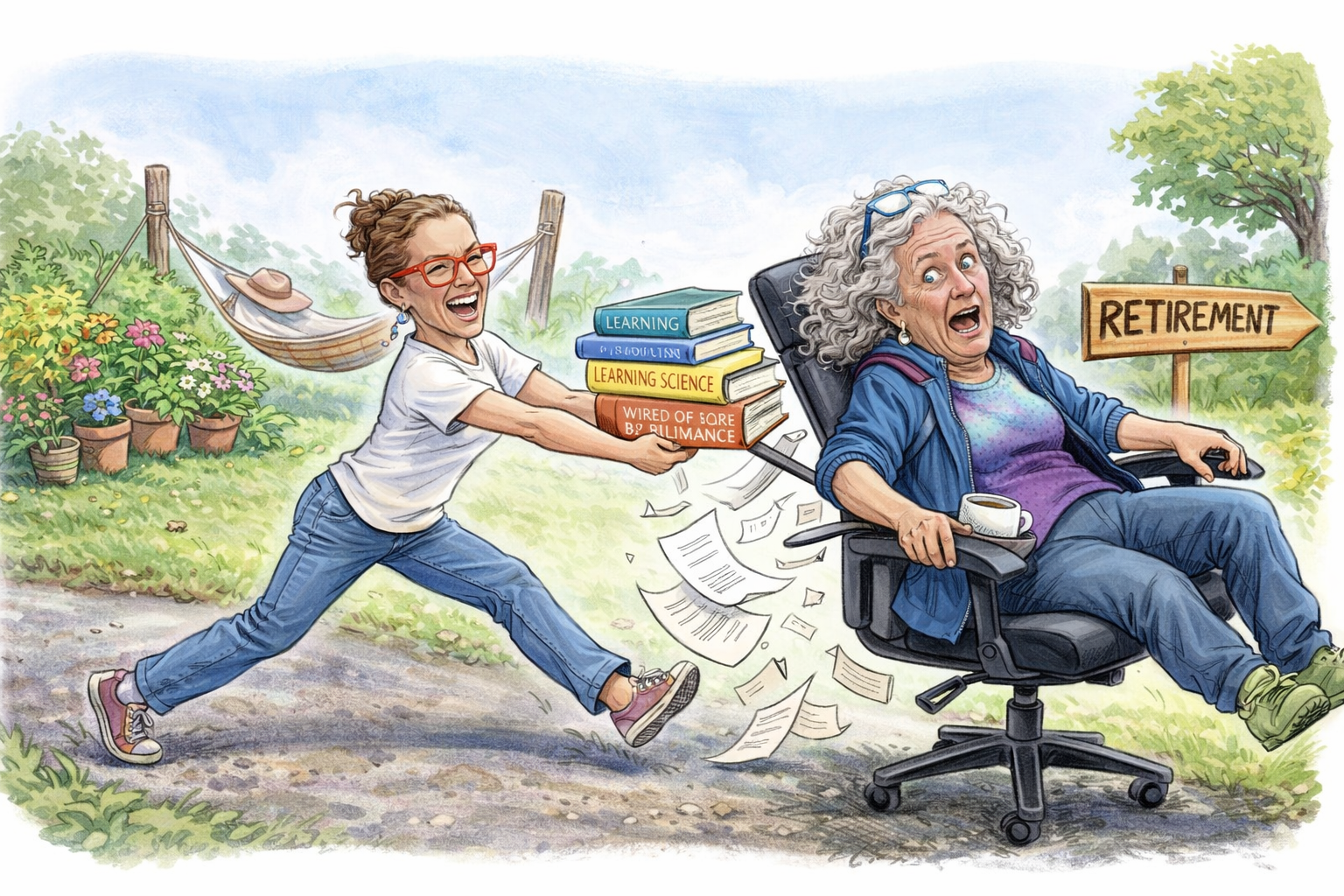
That is, until Sydney Schaef yanked me out of it.
After twelve years on the move with CompetencyWorks, I wanted to go slow. Morning coffee with a great book on my lap. Enough time to keep an eye on the sky—birds darting, clouds shifting, trees dancing.
What I didn’t expect was how existential retirement would be.
Underneath the beauty of all that open time was a constant itch, an unanticipated question: Who am I now? Without my lifelong purpose of trying to improve things for communities and their children, I found myself back in identity development—just as intensely as when I was thirteen, only this time without the pimples.
I needed a sense of purpose. So I kept working on a book that had been following me around for nearly ten years. It had gone through multiple drafts. All of which I had thrown out.
I wrote a book about how the concept of competency-based education developed. That wasn’t it. I wrote a book explaining what CBE is. Also not it. Plenty of books already did that.
So instead of how and what, I started asking why.
Why weren’t we seeing higher-quality implementation? Why wasn’t innovation spreading more quickly? Why was change so hard, even when teachers and school leaders were doing their very best? And why wasn’t the enormous, messy education ecosystem adjusting to what schools were trying to do to improve?
It began to feel like the field had climbed a steep rock face, reached the first resting ledge—and stopped.
Eventually, all of those questions led me back to one place: the research on learning. Over the past few decades, it has grown into a solid, coherent body of knowledge about how humans learn. And yet, it’s only dribbling into society—into schools, into workplaces, and into the hands of learners themselves. It’s a serious translation problem.
We’re living through an enormous paradigm shift. From fixed intelligence to neuroplasticity. From transmission of knowledge to agency. From a focus on engagement as behavior to one that emphasized emotional and cognitive engagement as well. And the list goes on. Even when we swim hard, progress in shifting from one mindset to another feels slow.
That’s when a different question began to take hold: What if everyone in the U.S. understood how learning actually works? Not just educators, but school board members, parents, policymakers, employers, and community leaders. Would it become easier to explain why the practices of competency-based education make sense? Would teachers have better tools for quality implementation and innovation? Would the people shaping policy begin asking a different question: In what ways is this rule helping—or hindering—the conditions for learning based on the research? Would parents begin demanding competency-based education because they understood the research behind it?
So a few years ago, I started writing again—this time with a different goal. I wanted to make the research as accessible as possible. Written so a school board member, juggling work, family, and the demands of volunteer leadership, could actually grab hold of it and use it to guide decisions.
That meant diving deep into the research and then sculpting it into clear frameworks. It meant explaining why the architecture of our school system creates enormous boulders that talented, committed educators have to chip away at, tunnel under, or carve paths around. And it meant translating the research into guidance for the broader education ecosystem—from schools to edtech providers to architects—about how to create the conditions for learning, for everyone.
That’s when Sydney Schaef entered the story.
What began as a quick catch-up call became life changing. I told her about the book. She shared the same vision: a world where the science of learning isn’t hidden in academic towers, but lives in the hands of students, parents, and the people shaping schools and the education system.
Where we differed was in how we saw the book itself. I thought of it as a closing chapter at the end of my career. Sydney saw something else entirely—a beginning.
So yes, she yanked me out of retirement.
Suddenly, I was back at my kitchen table each morning, coffee in hand, looking at my laptop instead of a book.
What started as “help me think this through” became a true collaboration. Sydney has a rare set of superpowers: she moves fluidly across research from multiple domains, sees through complexity with remarkable clarity, and translates big ideas into language that actually sticks. And her creativity—well, from what I can tell, there’s no off switch.
We threw out ideas. We followed new paths. We questioned our own assumptions. Along the way, our collaboration lifted Wired for Brilliance from good to great.
The idea may have started with me. But the book belongs to both of us.
And it turns out—I’m not really retired after all.
So stay tuned for Wired for Brilliance. We’ve got one more revision to do thanks to all the incredible feedback we got!
Bye for now,